Headlight Restoration 101:

Cloudy Headlight Restoration 101

Featured Post

Headlight Restoration 101:


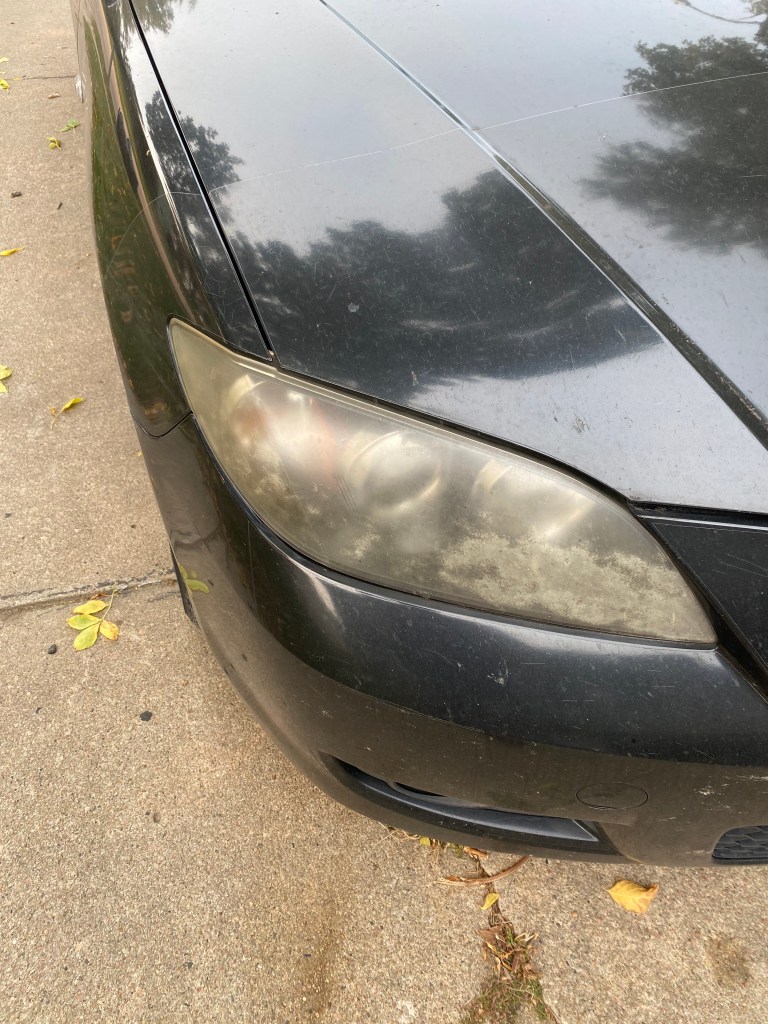
Headlights will begin to fade and yellow over time. This is common and happens on all cars from a $20,000 Honda Accord to a $150,000 Mercedes. As your headlights oxidize and become cloudy, the amount of light that is output decreases, driving at night becomes difficult and dangerous. This is due to oxidation on the lens as the plastic degrades with the sun’s UV rays.

I have been restoring headlights now (mine, customers, and friends and family) and have had great long lasting success with minimal effort and cost. With some simple tools 2 hours of time, you can save yourself from having to buy new headlights that can now reach upwards of $3000 each.


What you will need:

STEP 1

The first step is to clean and assess the extent of the repairs needed.
I first wash the whole car with extra detail to clean and dry the area around the headlights.
Use the micro fiber cloths to dry all the cracks surrounding the headlights. This needs to be dry for the tape to stick

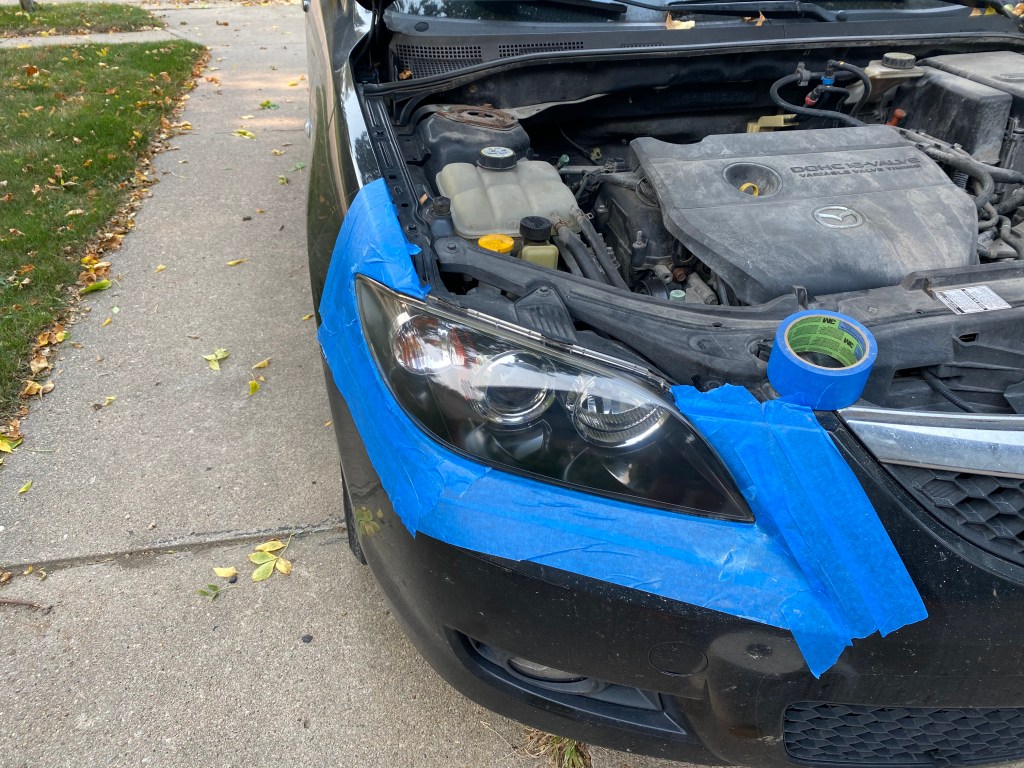
Start by making off the area surrounding the headlights.
I like to do one or two layers of tape directly next to the headlights so that if my sander gets away from me, I will not damage the paint or grills.
Apply more tape to expand the area covered surrounding the headlight. You can also use newspaper to protect even farther (I do this and recommend it, the aerosol clearcoat has a wide spray pattern)
Although it may seem excessive, but this step is critical.

STEP 2

Start by making off the area surrounding the headlights.
I like to do one or two layers of tape directly next to the headlights so that if my sander gets away from me, I will not damage the paint or grills.
Apply more tape to expand the area covered surrounding the headlight. You can also use newspaper to protect even farther (I do this and recommend it, the aerosol clearcoat has a wide spray pattern)
Although it may seem excessive, but this step is critical.

STEP 3

Now we start the sanding process.
There are 2 ways to approach this.
-Sand by hand
-Use a drill with an adapter and interface pad
By hand will be precise and you will have everything you need in the kit I linked to. But it will be more time consuming and has the potential for less mistakes.
If you go with the drill method, you will need to be careful not to sand too far, or accidentally sand off the headlight. if doing this, Be sure to go slow and in a controlled motion.
3.Start with the coarse grit sandpaper. Be sure to use a liberal amount of the “cleaning solution”(also known as rubbing compound)
Be sure to use a circular motion. This will be a time consuming step, take your time.
You will see the headlight go from yellow to clear, but will appear hazy.
4.Once you see get the full headlight to the same hazy but clear in color, its time to move on to the next grit of sanding pads.
Complete the same process but you will go from hazy to near clear. But that will go away with the next steps.

STEP 4

Spray the included Clearcoat.
Use a very light first coat.
Allow 3-5 minutes of dry time in-between coats.
Spray across the headlight in a horizontal direction.
Try and have each pass overlap by 50%.
Try your best not to spray too heavily and create runs in the coating.

Tips and Tricks

-Although this Write-up was using the Meguiar’s G2970 Two Step Headlight Restoration Kit the same applies for all of the other branded kits available. I personally like this kit because I can usually do 2-3 cars worth out of one kit.
-One thing to look for in kits or if you were to create your own process is the clearcoat. Although you can stop after the sanding/cleaning step, this clarity will not last. Without the clearcoat application, I have seen headlights start to oxidize within weeks. Although this process is not hard to do, I have been getting 1-2 years of clarity when using a clearcoat.
-Keep the headlights dry as possible after completing the clearcoat. I like to keep them dry for a few days if possible.
-Try do spray the clearcoat out of the sun, as it will accelerate the drying time
-Try to apply clearcoat on a non-windy day.
-If you do get some overspray, you can use rubbing alcohol to remove. Apply rubbing alcohol on a shop towel, never directly on the car’s paint

About Me

Hi, I’m Brad, Previously a technician, estimator and teacher of the automotive Collision repair industry, I saw a need for real world answers explained without the industry jargon to help people navigate the complicated world of getting your car repaired.

No comments to show.

How to Spot Prior Repair

When you are looking at a new used car there are many things to look for. Many are obvious, like cleanliness of the interior, tire condition, weird sounds, smoke coming out of the tailpipe, along with other others. (Check out this link for the checklist I use) But one thing to keep in mind is that if the car has been in an accident and repaired correctly, it should be hard to find signs of repairs. That is the ultimate goal of a quality repair shop. Unless you know what to look for.

As someone who has worked in the auto body industry for over 12 years I can usually find signs of prior repair, you just have to know where and what to look for. Here is list of things I always look for:

Vin Tags

Many people know that cars have a Vehicle Identification Number(VIN). All cars are required to have the VIN listed in the lower left hand corner of the windshield. But many car manufacturers actually have small stickers with the vin number on all the major bolted on parts. If the car you are looking at has had a fender replaced then you will notice the sticker is missing on one of the fenders.
A few common places to look:
-Doors.
-Fenders.
-Trunk lids, liftgates, and tailgates.
-Hoods.

Paint Hard Lines

When you have a part repainted at a shop the paint has to stop somewhere. When painting a house wall, for example, you can blend in spot of paint, like filling in a hole where a photo was, as long as it the same color you can end up only painting a small portion of that wall.
The same is not the case with auto body paints. Automotive paints are (in most cases) basically 3 layers thick, primer, color, and clear coat. If you have a small dent in the middle of a door you can keep the color layer to a small size but you have have to clear coat the whole door. (Click this link to learn about the blending process) With having to clear coat the full door (or more depending on the size of repair), the common and correct way to hide the “hard line” that is created when applying a clear-coat. (click this link to learn about what clear-coat is and benefits) When hiding a clear coat line, common practice is to wrap the clear coat around front he outside of the door to the inside, and even hiding it under a rubber door seal, behind interior door panels or under pieces of trim. This makes it not noticeable to the customer and is acceptable from a standards viewpoint. (Along with adhering to the guidelines required by the paint manufacturers, to be able to use those paint manufacturers guarantees)
So you should be looking for hardlines on all the panels of the vehicle. Do not be afraid to pull back the rubber seals and look to see if you can find a hard line.

Paint Overspray
Mistakes happen. While perfection is everyones goal, sometimes paint overspray is missed.
Paint overspray occurs when some paint gets past the masked off sections, (think when you use tape to mask off door frames when painting your home walls.), or the tape did not adhere well enough so the paint when sprayed went under the tape.
I always look in a few places: all the glass, door handles, exhaust pipes, roof racks, headlights and taillights, antennas, ext.

Mismatched Paint Color

Automotive paint is much more particular and precise than house paint. Automotive paint does fade overtime, especially if you live where you get a lot of sun (closer to the equator). While the paint manufacturers do make a truly good product, there are many factors to get a perfect match. It is not un-common for a particular color having what is called 10 variants. That means that the painter might have to mix up 10 different small batches of the same Nissan “Passion red code NBA” on some test panels. The painter then brings those test panels to the vehicle and picks the best match. It is good practice to do this is outside or using a “sun gun” (click this link to learn about sun guns) because the sun has different light qualities then the lights in the shop. What looks like a match in the shop could be a terrible match in the sun (where the customer sees their car 99% of the time)
One thing to remember is that the way the paint is absorbed in the plastic parts (think bumpers, mirrors ext) vs the metal parts does have an effect on the color. It is actually quite common for the bumpers on a car to not match the fenders even from the factory.
Side note, White is surprisingly one of the hardest colors to match. While black generally being the easiest.

Prior Paintless Dent Repair

Paintless dent repair(PDR) has been around for many years now. It is a great way to repair smaller dents and hail damage. It requires no painting of the panels, therefore keeping cost down, along with a much quicker turn around. (check out this article about PDR)
Sometimes PDR technicians will have to drill holes in the panels to gain access for their tools to reach a dent. While they do try to avoid this option as best they can, sometimes the customer will be ok with this practice to keep them from having to paint(and therefore raising the cost of repair). Look for small plastic flush mounted push in clips. they are the size of a quarter or smaller. You will see them on the inside of doors or in the door openings. If you find them and they are not symmetrical from right side to left side of the car, there is a good chance you have found a sign of prior PDR work.

Mismatched Headlight Clarity

Headlights are made of clear plastic, overtime the suns UV rays break down that plastic. Over time the plastic becomes faded or takes on a yellow hue. This is common and happens on all cars from a $20,000 Honda Accord to a 150,000 Mercedes. (Check out my write up on how to restore old faded headlights)
When a car gets in an accident many times the insurance will only cover the cost of replacing the damaged parts. Therefor you could end up with a bright, shinny, clear headlight on one side. This could be noticeable if the other side is older. (check out this link to my article about having a shop do extra work while in for repairs https://autobody.blog/headlight-restoration-101/ )

Frame Repair

When a vehicle is in a more major accident it is not uncommon for “frame repair” or “frame straightening”. This process involves using what is called a “Frame Machine” to pull the frame(or unibody structure) back to manufacturers specifications using using hydraulics, chains, and very precise lasers to get accurate measurements. (check out this write up on Frame Machines) . When tying the vehicle down, you use clamps and chains in very specific locations. On most vehicles this is called a “pinch weld”, it is the same location that you would use a jack to lift the car if you needed to change a tire. Look for signs of a clamp being attached to this point, like chipped paint or a texture to the metal that is not consistent the whole length of the “pinch weld”. the clams have a texture similar to the teeth of a set of vice grips or pliers, they leave that impression in the metal.
While this is a more rare sign of prior damage, it is worth always checking because it does indicate a more severe repair was needed on a vehicle in its past.

Latest Blog Posts

Cloudy Headlight Restoration 101

Featured Post Headlight Restoration 101: Headlights will begin to fade and yellow over time. This is common and happens on all cars from a $20,000 Honda Accord to a $150,000 Mercedes. As your headlights oxidize and become cloudy, the amount of light that is output decreases, driving at night becomes difficult and dangerous. This is…

How to Spot Prior Repair

When you are looking at a new used car there are many things to look for. Many are obvious, like cleanliness of the interior, tire condition, weird sounds, smoke coming out of the tailpipe, along with other others. (Check out this link for the checklist I use) But one thing to keep in mind is…

Headlight Restoration 101:

Featured Post Headlight Restoration 101: Headlights will begin to fade and yellow over time. This is common and happens on all cars from a $20,000 Honda Accord to a $150,000 Mercedes. As your headlights oxidize, the amount of light that is output decreases, driving at night becomes difficult and dangerous. This is due to oxidation…

How to Spot Prior Repair on a car

When you are looking at a new used car there are many things to look for. Many are obvious, like cleanliness of the interior, tire condition, odd sounds, smoke coming out of the tailpipe, along with many other others. (Check out this link for the checklist I use) But one thing to keep in mind…